Before They Sit Down
Rethinking lesson entry: when students arrive already overwhelmed

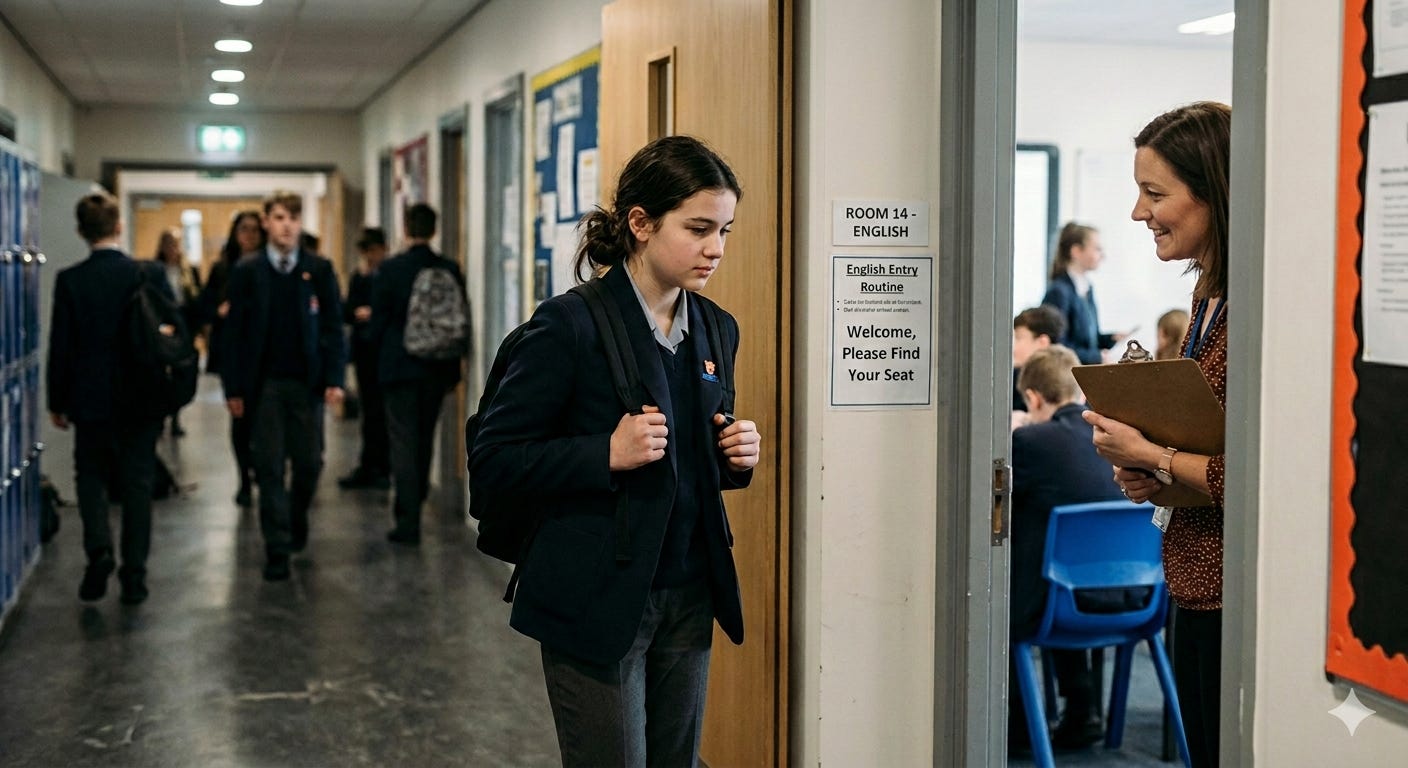
She stops at the door.
Not because she is refusing to come in, but because her body has already arrived at a decision her mind is still catching up with.
One step away from the classroom, everything tightens. The hesitation is only visible if you know what to look for. Inside the room, it already feels like it is moving without her.
It is not noise she is responding to yet, but the anticipation of noise. Not movement, but the certainty that movement will begin the moment she enters.
Her breathing becomes shallow, enough to continue, not enough to settle.
Her eyes scan the room in fragments. Nothing holds long enough to ground her. Everything is information, but nothing is stable. And underneath it all is a single question she cannot yet answer:
Where do I go where I will not be noticed too much, and not get something wrong straight away?
Corridor to Classroom
Recently, I’ve been working with students who are not struggling with learning itself, but with accessing the space where learning happens. When I speak to parents, the conversation rarely stays on curriculum or behaviour. It returns to one point: the doorway.
The moment between corridor and classroom is often treated as neutral. For many students, it is anything but.
And unless you are watching closely, it is easy to miss entirely.
What entry actually feels like
Take three students from a recent week.
Sophie enters quietly and efficiently. She is not disengaged, but carefully managing visibility. Her aim is to reduce attention quickly so she can regulate once seated. She often says she wishes she had an invisibility cloak from Harry Potter, something she could pull over herself so she could just get to her seat without feeling eyes on her.
Daniel enters looking for anchoring rather than attention. A brief nod, a predictable greeting, a sense that the space is stable. Without it, he is present but not settled. You can see it in the pause at the threshold, that moment where he is not quite in the room yet, as if he is waiting for something familiar to confirm it is safe to move.
Amira arrives already full. The environment feels louder and closer than it should, and she is managing far more internal demand than is visible. It is the noise that meets her first not uncertainty, but impact. Everything arrives at once: voices, movement, the shifting soundscape of the room. She knows her seat. That is not the challenge. The challenge is holding herself steady long enough to sit down without the world feeling like it is pressing in on her. Her words, not mine.
All three are doing the same thing, but experiencing entirely different thresholds.
The door is more than we think
The door is not just about a routine.
It is a relationship moment.
It is a regulation moment.
For some students, those few seconds before entry decide whether they can stay in school that day. Not because of behaviour, but because of what their body is already doing before any learning begins.
This is where knowing your students matters in small but precise ways.
Not in labels or categories.
But in detail.
Who needs space rather than closeness.
Who needs silence rather than explanation.
Who needs predictability more than variation.
Who needs the interaction to look exactly the same every morning, because consistency is what keeps them regulated enough to enter.
A simple “morning” can be enough.
But only when it is stable.
Only when it is familiar.
When a student responds “good morning, miss,” that is not always a social exchange. For some students it is effortful regulation a controlled act of holding themselves together in a moment that already feels exposed.
A calm acknowledgement “good morning, good to see you” is often enough. Nothing extended. Nothing added. Just steady presence so they can move through the moment without extra load.
The warm reset
The most important skill at the door is not just the greeting.
It is the warm reset.
Some students will not meet the expectation immediately. Not because they are refusing it, but because they are still organising themselves internally when the interaction arrives.
This is where the warm reset matters.
It is not repetition with frustration removed.
It is repetition with regulation embedded.
“Morning, let’s try that again.”
Delivered with the tone of a first attempt, not a correction.
No increase in volume. No shift in expression that signals disappointment. No added social weight.
Just a return.
For some students, particularly those with high anxiety or autistic profiles that return is what keeps the interaction intact. It signals that the expectation is still there, but nothing about the relationship has changed.
The reset does something precise:
It removes threat from correction.
It restores predictability without increasing demand. But tone matters more than words.
If the reset carries impatience, even subtly, the interaction changes shape. The student does not re-engage, they withdraw. Not because the expectation is wrong, but because the emotional signal has shifted.
This is why the door cannot be separated from relationships.
It is not a place of speed.
It is a place where regulation is either supported or disrupted in real time.
None of this is easy. It requires emotional regulation from teachers that is often underestimated. The warm reset only works if it is genuinely warm, not performed patience, but steady internal control when the interaction does not land cleanly. That is difficult. Especially when pressure is high and I know teachers have millions of things to do.
But it is part of the job.
The emotional regulation of adults is one of the conditions that allows regulation for students.
They are not asking for perfection.
But they are relying on consistency, calm, and repair when needed.
One student, one change, everything different
I met a student this week, I’ll call her Amy.
She is autistic and experiences high social anxiety, particularly in environments where she feels exposed.
On paper, her attendance looked inconsistent. But when we looked more closely, the pattern was clear: difficulty was not learning, it was entry.
In one classroom, her learning passport stated she should sit at the back. This was appropriate and supportive. But the layout meant she had to walk down a long narrow space with students on either side.
For Amy, that walk was not neutral. It was exposure in motion. Each step increased awareness of being seen, and by the time she reached her seat, she was already at maximum load.
On some days, that was enough to prevent entry altogether.
So we changed one thing.
Amy now enters first, before the room fills, before attention settles, before visibility increases.
From the outside, it is a small adjustment. From her perspective, it changes everything.
Seating is never neutral
Seating is often treated as organisation.
For some students, it is emotional geography. It shapes predictability, safety, and regulation in ways that are not always visible in planning.
I worked with a student, Luke, where a change elsewhere in the room shifted his sense of stability. Not because anything obvious changed, but because the pattern he relied on had altered.
For him, predictability is what allows access to learning. When that shifts, regulation becomes harder.
What strong lesson entry actually looks like
Strong entry is not about speed.
It is about removing uncertainty.
Students enter knowing where they are going, no scanning, no negotiation, no social ambiguity.
Teacher presence is calm and consistent, not reactive or performative.
Greetings are familiar and stable, not variable.
No new demands are introduced at the threshold.
The room is already set before the student arrives in it.
Strong entry does not add more.
It removes friction.
What we should be asking ourselves
If entry is a moment of regulation AND routine, the questions shift. Not towards blame, but towards design.
Do students have to negotiate space, attention, or social expectation before they can sit and begin learning?
Is the first interaction predictable enough for students who rely on structure to regulate?
Are we expecting social performance at a point where some students are still managing internal load just to be present?And if a student is not settling, are we sure the barrier is learning — or have we ruled out entry as the difficulty?These are not checklist questions.
They are design reflections.
Final thought
The walk through the door.
The scan of the room.
The sense of being seen before they are ready.
Strong lesson entry does not ask students to change who they are in that moment.
It changes the conditions so they do not have to.
And that shifts the question from:
Why can’t they settle?
to
What would it take for them to be able to enter?
And more importantly:
What are we unintentionally asking them to survive before learning begins?
This resonates with something I keep noticing in assessment.
By the time a student sits down for an exam, much of the important learning has already happened—or failed to happen.
The final answer sheet is only a snapshot. It doesn't show the misconceptions, moments of confusion, revisions, or conceptual breakthroughs that came before it.
One reason I'm interested in building QUASAR is that assessment becomes far more useful when it helps reveal the thinking process behind an answer, not just the answer itself.
I really enjoyed this article. It's so important to see the student perspective and think about their internal experience rather than external behaviour.
May I suggest that you experiment with a non-compliance-based entrance routine? Rather than expect a certain response, instead give praise or make it your mission to elicit a genuine smile.
I was one of the kids who lived with high anxiety and trauma. My anxiety was triggered by adults, and I was hypervigilant. I had learned that not getting something 'correct' was dangerous. The problem was, I couldn't do these social rituals (and I still can't get them right!). Me lining up would have been (in my head) "say, 'hello miss', say, 'hello miss', say, 'hello miss'..." Then, when you say 'hello', I blurt out "miss", and you kindly correct me. But now I'm in panic mode, even though you are kind and safe for me. I'm panicking because I'm calling myself stupid, thinking I've messed up again, that I'm no good, and I never get it right.
Yes, teachers need to be regulated, but imagine a room entrance routine that doesn't have a single 'correct' behaviour. One that says, I see you, and I value you for who you are. Or one that supports every kid to enter with a genuine smile on their face.