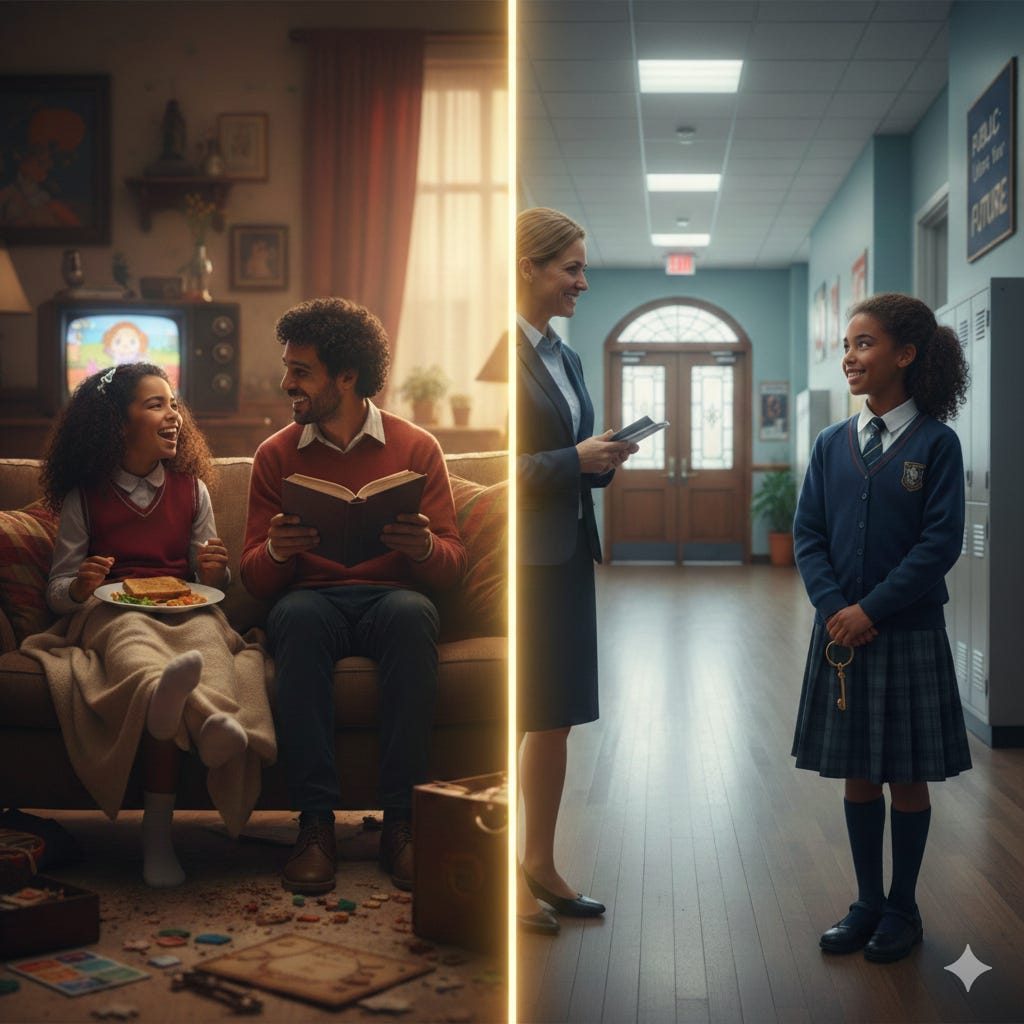
The Public Code: Handing Over the Keys to the Room

Why school standards are the infrastructure of social mobility
As teachers, we often talk about manners and behaviour in school as though they are isolated skills, but in reality, they are rehearsals for life. As we know these rehearsals teach attention, patience, adaptability, and social awareness. By noticing the habits children bring with them, we can guide them in learning the Public Code that helping them navigate new spaces, read social cues, and communicate with confidence.
Every household has its own culture, its own rhythm, and its own set of invisible rules.
Some families eat together; some on laps, some scroll while they chew. Some wait for the last person to finish; some start the moment the plate hits the table.
None of these automatically indicate love or its absence.
They indicate norms. Children grow up assuming, “This is how it’s done,” until they enter a wider space school, university, work and realise there are other ways of being.
My own home
When I look at my own house, I see the deliberate construction of my daughter through the expectations I set:
Sundays are formal. Phones are away (relegated to a kitchen draw). We wait until everyone’s food is on the table before starting no excuses, no shortcuts, no "ninja-forking" a roast potato while the carver is still working. Plates are passed politely, sides are shared, and conversation hums. Even small slips like reaching for a condiment without asking become tiny, slightly dramatic lessons in patience and self-awareness.
Sundays are also for deeper talk, considered conversations that sometimes drift into world events, or moral questions. The table becomes a training ground for thought, curiosity, and expression. These are the moments where my daughter tests her reasoning, discovers that "because I said so" isn't a valid debate tactic, and learns that timing a joke is as important as the punchline itself.
Fridays are the exact opposite. The week has been long, and everything collapses into a state of horizontal flexibility. Feet are on the sofa. Plates are balanced precariously on knees (a high-stakes game of "Don't Spill the Ketchup"). The television hums in the background, serving as the evening’s ambient heartbeat. Conversations zigzags from one topic to the next with no regard for logic or flow. It’s also messy, the floor is 40% crumbs, but it teaches its own lessons. Freedom, choice, and the ability to decompress without becoming a total feral are skills too!
The Wagamama Lesson
Yesterday at Wagamama, the requirements shifted again. Plates arrive at different times, you start eating as soon as it arrives, it’s a different rhythm, my daughter has her book to share facts while she waits for her food.
At one point, she asked for my phone to scan a QR code in the encyclopedia. Seeing my raised brow, she quickly added, “Mum, it’s just for the code!” clearly aware that phones aren’t allowed at the table. I couldn’t help thinking how ridiculous it was: who puts a QR code in an encyclopaedia anyway?
While we waited for our ramen, she launched into a lively lecture on the Blue Viper explaining, in meticulous detail, exactly how it might kill us all on our next trip in a few weeks. In that moment, she was learning more than snake facts. She was noticing the timing of plates and how others were eating, practicing attention and focus by staying fully present, adapting to a new rhythm outside the home, and testing her communication skills as she shared her knowledge and gauged our reactions.
The Diverse Rehearsal
While I am teaching Alice the "Wagamama shift" other parents are running their own rehearsal.
For many of our students, the rehearsal is the toast they are making for themselves because both parents are out at work, grafting to keep the lights on. Independence is their primary manner. In other homes, the rehearsal is the high-stakes competition of a crowded kitchen, where the loudest voice wins. In that environment, "waiting your turn" means missing out; interrupting isn't being rude, it’s how you participate. It’s a rehearsal in projection, speed, and asserting your presence just to be noticed.
None of these children are "wrong." The child making their own toast or the child who has learned that the loudest wins is showing a level of competence, resilience, and adaptability that is entirely valid. But when they walk through our school gates, they are entering a third environment. They are entering the Public Code.
If we don't acknowledge the different rehearsals they’ve come from, we risk seeing the "loudest wins" habit as simple aggression or the "toast-maker’s" independence as defiance. Our job is to respect the home rehearsal while giving every child the tools to master the professional one.
Why we teach
Manners are not evenly distributed. This is why we must be explicit. We cannot assume students "know better," because in their world, they are doing what is right.
We need to tell our students:
The way you speak at home is your heart. But the way we speak here is how you speak in a professional world. We are teaching you this so that you can navigate any environment. We aren't changing who you are; we are giving you the keys to every room.
We have to start treating manners like infrastructure of a successful life and a part of the curriculums we teach.
If we don’t explicitly teach the Public Code, we are effectively deciding which students get to "belong" in professional spaces and which will always feel like outsiders. We are gatekeeping their future by our own silence.
If a student leaves our school with ten GCSEs but can’t look an employer in the eye or navigate a room, have we actually succeeded? Or have we just sent them into a world where the doors remain locked because we never gave them the keys.